

February 6, 2023
- URL
Electrical enclosures can pose serious safety risks unless they are well-regulated. To keep businesses and people safe while operating equipment, an organization known as Underwriters Laboratories (UL) is responsible for setting the standards used in electrical junction boxes, cooling apparatuses and other electrical systems.
The UL has authority thanks to the U.S. National Electrical Code® (NEC®). The main job of the group is to evaluate equipment and tools based on the standards in place. Should a product meet the standards required for optimal usage, the UL will approve it for use in commercial or industrial projects.
Each standard is usually based on the environment and use cases of any given product. Extra safety concerns must be addressed in areas of extreme temperature or humid spots prone to becoming damp. While the chance for an electrical fire will always persist, the frequency of accidents can be significantly reduced through strict adherence to the UL and cUL (the Canadian version of Underwriters Laboratories) requirements.
Explore UL-listed Junction Boxes Here
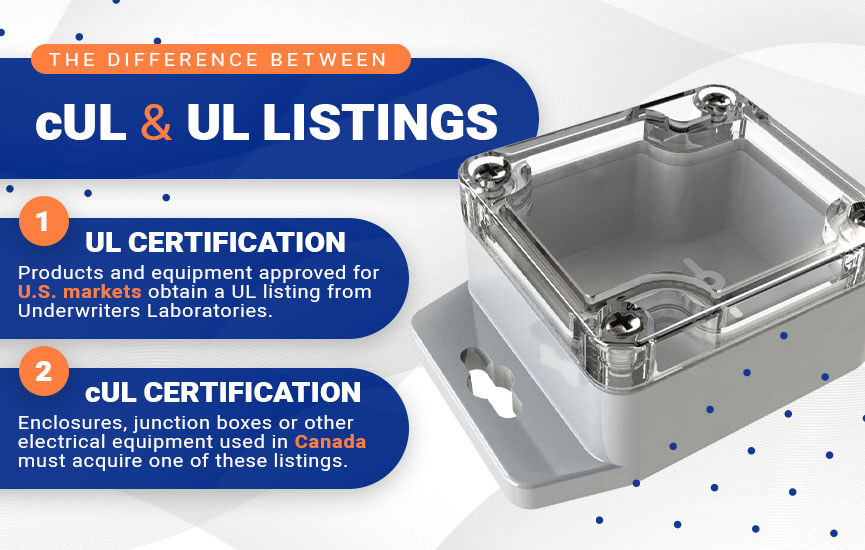
Products and equipment approved for U.S. markets obtain a UL listing from Underwriters Laboratories. Just as with Canada, the United States has a set of standards that manufacturers and developers must adhere to. The standards themselves are listed by the National Electrical Code® in the ANSI/NFPA 70 section. An example of these standards is ANSI/UL 484, which governs the requirements for specialty air conditioners throughout the country.
A cUL certification is specifically developed for Canadian markets. Essentially, any enclosure, junction box or other pieces of electrical equipment used in Canada must acquire one of these listings. The Canadian Electrical Code has its own set of standards to abide by. The main requirements to adhere to are spelled out in CAN/CSA 22.1-12, which are clauses established by the Canadian Standards Association.
Examples of these requirements include section 22.2, which focuses on heating and cooling equipment. The section is further split into areas, such as 236-MGO, that designate specific pieces of equipment. In the case of 236-MGO, the standard describes heaters and other warming equipment.
Although the protocols used by both Canada and the U.S. are largely the same, there are plenty of notable differences. You will always want to abide by the exact standards set out by your country of operation. In general, the set of cUL standards reflects European sensibilities. One example of this is the consistent references to the IPXX enclosure rules in place across Europe.
As for UL designation, the United States tends to rely on NEMA ratings to set the standards for UL-listed junction boxes and electrical enclosure equipment. The National Electrical Manufacturers Association regulates the implementation of junction boxes and other equipment for safety purposes and optimal efficiency during regular usage.
Get Great Deals on Our Selection of Electrical Enclosures
When talking about UL certifications, there are two different marks to consider. A UL listing is established for an entire product, whereas UL certification is reserved for individual components of a product. Since electrical components are often comprised of several pieces, each one can be certified as meeting the standard. For instance, each individual valve or switch must be certified, even when they serve identical purposes within the same system of infrastructure. If the entire enclosure or junction box is fitted with certified parts, it will earn the full UL listing. For a more detailed comparison, you can read our blog on UL listed vs. UL certification.
The process of obtaining certification is purposefully strict for the sake of everyone’s safety. However, the guidelines are straightforward, and the goal is to ultimately approve as many projects as possible once they are proven to be under sound management. Applying for certification is rather expensive, so companies are urged to follow each standard as closely as possible. Here is a breakdown of the most common sets of standards to take note of.
This extremely common standard is used in each of the three North American regions. The U.S. falls under the National Electrical Code® NFPA 70®. Canada primarily uses CSA 22.1, and Mexico’s el NEC is essentially the same as the NEC®. When working in one of the above countries, specific rules must be followed to the latter. However, special exemptions can always be made for unique cases. Companies and organizations work with regulators to make agreements during circumstances not covered by the base guidelines already established.
For more delicate installations that require low output, UL 248-1 is used in all three of these North American countries. The uniformity across regions is crucial to keep devices and operators safe from the precarious state of low-voltage electrical components.
As most brands and organizations aim to reach across the globe, Underwriters Laboratories have prepared methods for unified testing. This allows a single product to be tested for both cUL and UL certifications simultaneously. Evaluating products in a holistic manner dramatically increases how quickly manufacturers can bring new offerings to each market. Underwriters Laboratories also benefit from unified testing as they can test products more efficiently.
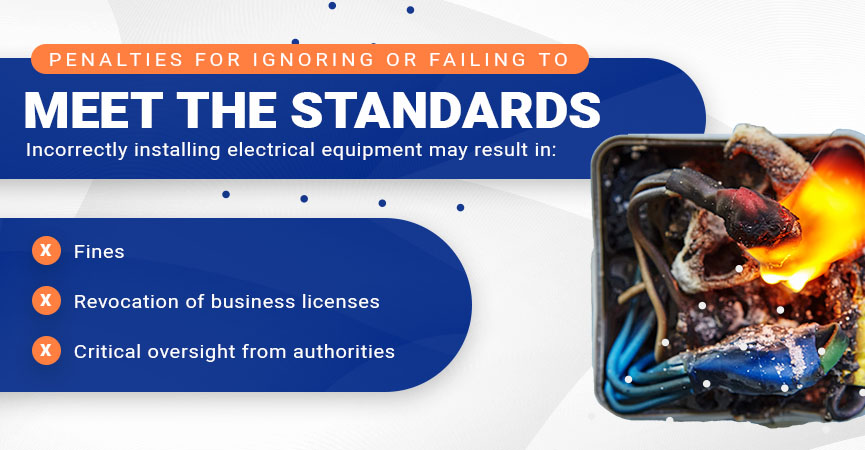
Authorities in both the U.S. and Canada will reprimand anyone caught installing electrical equipment or enclosures that do not meet all listed safety requirements. The penalties depend on the severity of the transgressions and a company’s track record of abiding by the standards in the past. Incorrectly installing electrical equipment may result in fines, the revocation of business licenses and more critical oversight from authorities in the future. This makes closely following each standard a must for any business or organization that relies on electrical components for daily operations.
There are several things that can go wrong that may result in fire damage and other electrical anomalies. Keep in mind that the risk of any of these events goes up dramatically the longer an operation is running. This is why having fully certified equipment is the best protection against catastrophic incidents.
Using top-of-the-line machines may sound like an excellent idea at first, but the increased output puts a massive strain on the server network. Unless the server is also fortified in tandem, hardware upgrades can become too much for the existing infrastructure to handle.
Each network device should be laid out and installed with peak efficiency in mind. Should enough server components be placed haphazardly, the pipeline slows to a crawl and undue strain is placed on the system. This results in the same damage seen from using hardware that is too advanced. Always rethink your network structure to make the layout as efficient as possible.
As a company or group grows in size, it can be tempting to rely on the same old network to house each new terminal or computer. However, your existing infrastructure is only designed to withstand so much traffic at once. If you expand too quickly, your equipment may give out or overheat. Upgrading the capacity of your network should always come before any major hiring sprees or partnerships are finalized.
The longer each electrical device or cable is in use, the more heat will be generated. Your networked components all need some rest to keep the temperature down. When you have to transfer enormous amounts of company data or other assets, either take it slow or consistently check your cables and enclosures for excess heat.
Hackers and other cybercriminals can introduce a variety of detrimental effects to your network. The nature of any given attack may vary considerably, but the unorthodox use of server equipment by outside forces can damage it in a hurry. For instance, hackers can make equipment overheat and catch fire by sending large packets of data over to the network they are targeting.
Acquiring enclosures and electrical components for your company office or industrial building does not have to induce headaches. At Polycase, we have friendly staff waiting to help you out with any questions and with placing your order. In addition to products that meet UL standards, you also want to ensure each enclosure is made with quality materials.

Take our plastic enclosures as an example. The outer shell is comprised of a flameproof ABS molding and impact-resistant polycarbonate. This makes them ideal for both indoor and outdoor applications. You can further customize your enclosure with a variety of colors, sizes and form factors. This means you can always find a suitable piece for any project or piece of equipment being installed.
Electrical components are used in nearly all parts of modern infrastructure. Important societal services such as trains, medical equipment and industrial manufacturing rely on stable equipment. This is why cUL and UL certifications are taken into serious consideration by businesses and authorities alike. With the sheer number of fundamental projects to protect and the various ways something could go wrong, a strict set of standards is the best way to keep everyone safe in the long run.
Image Credits
Grigvovan/Shutterstock.com
VITALII BORKOVSKYI/Shutterstock.com
sidmay/Shutterstock.com