Same Day Shipping 

On in-stock orders placed by 3:00pm EST (Monday-Friday)

RoHS & Reach Compliant 1-440-934-0444

Resources
  • About
  • Shipping Info
  • FAQs
  • Learning Center
  • TechTalk Blog
  • Reviews
Contact
  •   Call Us 1-440-934-0444
  •   We're online Live Chat
  •   Contact Us
My Account
  • My Dashboard
  • My Quotes & Custom Parts
  • My Orders
  • My Compare
  • My Project List
  • My Wishlist
  • Sign Out
My Cart
Toggle Nav Polycase Logo Polycase Logo Toggle Nav
Menu
  • Products
    • Enclosure Categories
      • By Application
        • Outdoor
          • Waterproof
          • Electrical
          • Junction Box
          • Pole Mount
        • Indoor
          • Desktop
          • General Use
          • Handheld
          • Key Fob
          • Plug-in
          • Potting Box
          • USB
          • Indoor Waterproof
      • By Material
        • Plastic
          • ABS
          • Polycarbonate
        • Metal
          • Aluminum
            • Diecast Aluminum
            • Extruded Aluminum
          • Steel
            • Stainless Steel
            • Carbon Steel
      • By Design Feature
        • Battery Compartment
        • Clear Cover
        • Din Rail Enclosure
        • Flanged/Surface Mount
        • Hinged Cover
        • Knockout
        • Lockable
        • Low Profile
        • Snap Together
        • Made in USA
        • Best Sellers
      • By Rating
        • NEMA Rated
          • NEMA 1
          • NEMA 2
          • NEMA 3R
          • NEMA 4X
          • NEMA 5
          • NEMA 6P
          • NEMA 12
          • Show All
        • IP Codes
          • IP65
          • IP66
          • IP67
          • IP68
        • UL Listed
    • Enclosure Solutions
      Shop Best Sellers
    • Accessory Categories
      • Cable Glands, Plugs & Venting
      • Waterproof NEMA Accessories
      • Panels
      • DIN Rail Kits
      • Pole Mount Kits
      • Screws
      • Potting Box Covers
      • Mounting Kits
      • Misc. Accessories
      • Shop All
  • By Size
  • By Series
    • Menu 1 - Tabs
      • A - E
        • AG
          AG Series
        • AL
          AL Series
        • AN
          AN Series
        • BF
          BF Series
        • BT
          BT Series
        • BX
          BX Series
        • DC
          DC Series
        • EK
          EK Series
        • EX
          EX Series
      • F - M
        • FB
          FB Series
        • GS
          GS Series
        • HD
          HD Series
        • HN Series
          HN Series
        • HP
          HP Series
        • ID
          ID Series
        • JB
          JB Series
        • KT
          KT Series
        • LP Series
          LP Series
        • ML Series
          ML Series
      • N - T
        • NX
          NX Series
        • PM Series
          PM Series
        • QS Series
          QS Series
        • RW Series
          RW Series
        • SA Series
          SA Series
        • SB Series
          SB Series
        • SG Series
          SG Series
        • SK Series
          SK Series
        • SL Series
          SL Series
        • SN Series
          SN Series
        • TS Series
          TS Series
        • TX Series
          TX Series
      • U - Z
        • USB Series
          USB Series
        • VK Series
          VK Series
        • VM Series
          VM Series
        • WA Series
          WA Series
        • WC Series
          WC Series
        • WH Series
          WH Series
        • WP Series
          WP Series
        • WQ Series
          WQ Series
        • XR Series
          XR Series
        • ZH Series
          ZH Series
        • ZN Series
          ZN Series
        • ZQ Series
          ZQ Series
      • View All
    • Accessories By Series
      • PCB Mounting Screws
      • PCB Mounting Standoffs
      • Pole Mount Kits
      • DIN Rail Kits
      • Cable Glands and Seals
      • Venting Accessories
      • SHOP ALL
  • Cutouts & Graphics
    • Menu Item
      • CNC Machining
        CNC Machining
      • Digital Printing
        Artwork & Logos
    • Menu Item

      Customize Your Polycase Enclosure

      Instant Quote

  • Customization Quote
Account
Search
Advanced Search
  • My Compare ()
  • <
  • Tech Talk
September 25, 2019

Carbon Steel VS Stainless Steel: What’s the difference??

In Metallic Enclosures, Steel Enclosures
Share
What's the Difference Between Carbon Steel and Stainless Steel
Steel is one of the modern world's most important materials for building and engineering. Its incredible durability and versatility make it useful in everything from homes to commercial buildings to industrial machinery, and you’ll find it almost everywhere you look and in many different industries.The properties that make steel popular around the world also make it one of our most popular enclosure materials at Polycase. Our customers find that our steel enclosures offer a lot of great advantages, including:
  • The ability to resist severe weather conditions like rain, snow and sleet
  • Excellent security and resistance to unauthorized access
  • High resistance to corrosion in stainless steel enclosures
  • Substantial protection against airborne dust and debris
You also might be wondering: What gives steel these properties? And what’s the difference between the common types of steel you often hear about, such as carbon steel and stainless steel? We’ll take a dive into what makes steel such an important material, the question of carbon steel vs. stainless steel and what Polycase’s steel enclosures offer our customers.steel machinery

What Is Steel Made of?

First, let’s talk basics: What exactly is steel made of that gives it its properties?We begin with iron. Iron is a useful and common element, but it’s too soft by itself to be suitable for construction, tools and the many other applications you’ll find steel used for. By creating an alloy of iron and carbon, the metal is made much stronger and more durable. This purified and enhanced metal alloy is called steel. Other key parts of the manufacturing process include adding elements like chromium, manganese and nickel, as well as removing undesirable ones like nitrogen, sulfur and phosphorus.How do you get from raw iron ore to the steel that builds our homes, tools and communities? That happens through the complex process of steel-making — one of the industries that built the modern American economy as we know it.

The Steel Manufacturing Process

The differences between carbon and stainless steel start with the manufacturing processes used to create them. All steel begins its life through the same basic manufacturing process, but other materials can be added at various points to create different varieties of steel with different properties.The basic process of manufacturing steel involves smelting iron ore to extract iron, removing the excess carbon and other impurities and then using a variety of finishing processes to create a strong, versatile and attractive material. A typical steelmaking process works like this:
  1. Iron ore, coal, limestone and other materials are poured into the top of a superheated blast furnace. Molten iron collects at the bottom, while impurities collect on top of it into a slag that’s drained off.
  2. During the primary steelmaking stage, the molten iron is purified and combined with scrap steel using one of two processes: Basic oxygen furnaces, in which high-purity oxygen is blown through the mixture of molten iron and steel to further burn off impurities. Basic oxygen steelmaking is the most popular method of steel manufacturing.
Electric arc furnaces use huge graphite electrodes to melt down the iron and remove impurities while scrap steel is added to the mixture.
  1. Next comes secondary steelmaking, in which the raw molten steel is manipulated through a variety of techniques, usually involving an enormous mechanical device called a ladle. This stage of the process includes key procedures that produce different types of steel such as argon-oxygen decarburization, a complex technique that removes excess carbon from stainless steel.
  2. Once the purified steel has been created, it’s time for primary forming. In this step, steel is poured into various molds to shape it into different forms – depending on its application. This can include bars, beams, sheets and many other different forms. More ductile types of steel, such as austenitic stainless steel, are more easily able to take on a variety of shapes.
  3. The final step is the finishing or secondary forming process, in which steel is given its final form. This includes the processes like galvanizing, machining and welding that turn steel into usable products that build the world around us.
One of the most incredible things about steel is how different alloying elements and techniques can create many types of steel that are ideally suited to their applications. Next, we’ll see how two of the most common types — carbon steel and stainless steel — have unique properties that can be put to use for your electronics enclosure needs.

Carbon Steel vs. Stainless Steel: Understanding Key Differences

Although some of the benefits of stainless steel and carbon steel are the same, they also have some characteristic differences that make them suitable for different applications. To make sure you’re getting the right material for your application, it’s important to understand the similarities and differences between carbon and stainless steel. Before we jump in, remember that the terms “carbon steel” and “stainless steel” each refer to a wide variety of materials. Here, we’ll only be talking about the most widely-used types of each.Composition differences

Composition

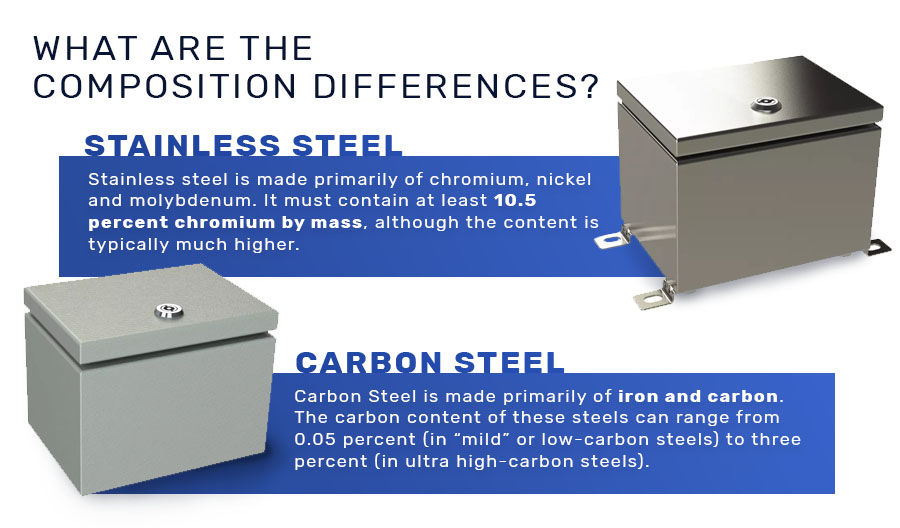
All steels are composed mainly of iron and carbon. Some, however, contain additional elements that give them their unique and useful properties. By controlling and changing the elemental composition of steel, steelmakers can create a huge variety of steel alloys suitable for many different purposes.The magic ingredients for stainless steel are chromium, nickel and molybdenum. Stainless steel must contain at least 10.5 percent chromium by mass, although the content is typically much higher. Many varieties of stainless steel also contain some quantities of nickel and molybdenum to give additional desirable properties.The term “carbon steel” typically means any steel whose primary ingredients are iron and carbon. The carbon content of these steels can range from 0.05 percent (in “mild” or low-carbon steels) to three percent (in ultra high-carbon steels).

Cost

The cost of steel can vary widely according to the form you’re buying, the composition of the steel and many other factors. In general, stainless steel costs more than mild- or medium-carbon steel. Very high-carbon steel, however, can be comparable or greater in cost to stainless steel. Since there are numerous factors in play that determine how much you’ll pay for steel, the best method is typically to determine the specific performance factors you’ll need and then investigate your options and how much they’ll cost.

Corrosion Resistance

Here’s where stainless steel gets its name and reputation. Steel, while still a highly durable material, is vulnerable to corrosion and pitting. Corrosion is a result of the oxidizing process — that is, metals such as steel having electrons “stolen” by oxygen in air or water. When this happens to steel, the oxidized patch will become an iron oxide, typically the one known as “rust” — which, as we all know, can create big structural problems when present in large amounts.why is stainless steel corrosion resistantvMetals that resist corrosion usually have some kind of protective layer that prevents their metallic structure from undergoing destructive oxidation reactions. With stainless steel, that protection comes from the chromium alloyed into the metal. The chromium reacts with oxygen and forms a layer of chromium oxide that helps the steel beneath it resist corrosion.Carbon steel, while good for many things, is often vulnerable to corrosion because it lacks protection against oxidation. For applications that need corrosion resistance, such as food service and marine environments, most regulations require the use of stainless steel.
Tensile Strength and Yield Strength

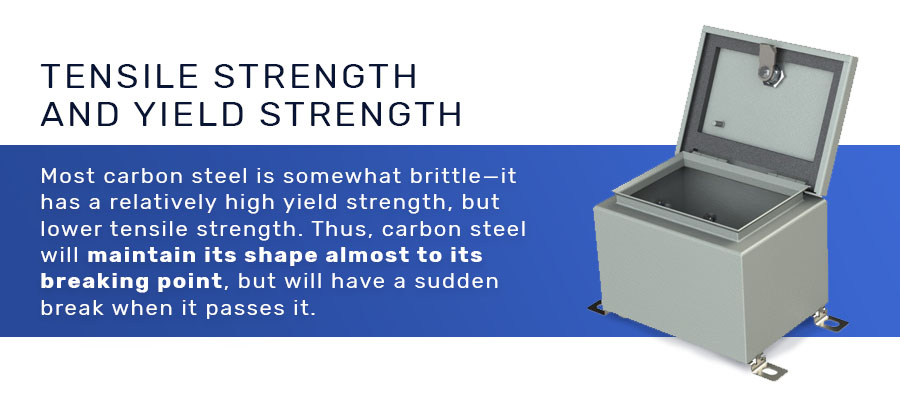
Many applications require steel that resists breaking or becoming deformed when pulled on by physical forces. These mechanical properties are typically measured by two metrics: yield strength and tensile strength, each of which refers to a different type of strength testing. Yield strength is the amount of force that will cause steel to become permanently deformed by bending or denting. Tensile strength is the amount of force that will cause steel to rupture or crack.Tensile Strength and Yield StrengthDue to its low carbon content, most stainless steel is somewhat softer than carbon steel and thus has a fairly low yield strength. This means that it’s more vulnerable to denting and bending than carbon steel. Most carbon steel, on the other hand, is somewhat brittle. It has a relatively high yield strength, but lower tensile strength (depending on the amount of carbon present). Thus, carbon steel will maintain its shape almost to its breaking point, but will have a sudden break when it passes it. (Think of a carbon steel knife blade for an example. It strongly resists bending, but will snap if enough pressure is applied.)

Machining and Welding

Customizing enclosures through machining and welding is a key process for many of our customers, so it’s important to know the difference between carbon and stainless steel here as well. Stainless steel is cutting tools and requires special techniques to machine efficiently. It’s also generally considered more difficult to weld than carbon steel, although it’s certainly not impossible and is done every day.Carbon steel, by contrast, is a go-to material for all kinds of manufacturing today. Mild steel is especially important due to its ductility and weldability, which allow it to be formed into a huge variety of steel products — from automotive components to building materials. High carbon steel, meanwhile, is prized for its high strength and ability to maintain a sharp cutting edge, which is why you’ll see it in many applications such as professional chef knives.

Appearance

While aesthetic appearance likely isn’t the top quality you’re looking for, it can definitely play a significant role in crafting the environment you’re looking for — so it’s worth noting the visual qualities of each type of steel.Carbon steel is a fine-looking material that’s got the sleek, smooth look that’s typically associated with steel. It will also take a variety of coatings and finishes, providing a wide range of aesthetic options for all kinds of environments. However, most carbon steels don’t have the shine and luster of their stainless cousins.Stainless steel, of course, is famous for its attractive qualities. The high chromium content of stainless steel has an added benefit: It creates a brilliant and eye-catching look. These aesthetic qualities, in addition to its corrosion resistance, make stainless steel a popular choice for home appliances and all kinds of applications where high-end aesthetics are a concern.

Heat Resistance

Stainless steel is also notable for its superior resistance to high heat. Although both carbon and stainless steel can easily resist everyday high temperatures due to their low thermal conductivity, most stainless steels maintain their strength at temperatures of up to around 1,000 degrees Fahrenheit. Steel types with a high carbon content will generally have less resistance to extreme temperatures.

Food- and Marine-Grade Steel

Steel used in food service and marine applications must have corrosion-resistant properties to maintain its integrity due to these environments’ inherent hazards:
  • Food-grade steel must resist corrosion from frequent wash-downs, contact with cleaning chemicals and/or contact with highly acidic foods such as lemon juice.
  • Marine-grade steel must resist corrosion from constant contact with salt water.
Stainless steel is the preferred choice for both of these applications due to its excellent corrosion resistance. Type 304 stainless steel, which Polycase stainless steel enclosures are made from, is considered to be a marine-grade stainless steel and food-grade stainless steel.

Steel Enclosures from Polycase

Polycase offers a variety of material choices for our enclosures, and steel enclosures are some of our most popular. Their classic elegance and rugged construction make them a great choice for a variety of applications – from machinery control panels to scientific instruments.
  • Our SA Series stainless steel enclosures are NEMA 4X enclosures that have made us an industry leader, thanks to their exceptional durability and high-quality construction. These enclosures are crafted from 304 stainless steel, the most popular grade of stainless steel used around the world, and are NEMA-rated to the powerful NEMA 4X standard for protection against ingress of solids, ingress of liquids and corrosion. They also meet international IP66 ingress protection standards. The SA series even comes standard equipped with a keyed latch for secure access, plus mounting brackets and an internal panel. Last, but not least, they’ve got the sleek look of stainless steel that gives any application a stylish and professional look.
  • Our SB Series carbon steel enclosures also offer excellent protection and performance at a lower price point. They’re manufactured with high-quality 16-gauge carbon steel and feature a waterproof, dustproof gasket that meets NEMA 4X and IP66 ratings. That means that they’re weatherproof and waterproof, offering the performance you need whether indoors or outdoors. The SB Series features a classic gray powder-coated finish that fits perfectly in a wide variety of settings.
Polycase SA-37 Stainless Steel Enclosure

Polycase SA-37 Stainless Steel Enclosure

Steel is a critical part of how our world is built, and whether it’s a stainless steel enclosure or carbon steel enclosure that you need, Polycase can help you make your next project a success. Give us a call at 1-800-248-1233 if you’ve got more questions about our steel enclosures or contact us online.
In Metallic Enclosures, Steel Enclosures
0 Comment

Stay in the Know

We'll send product news and knowledge right to your inbox

Newsletter
  • Twitter
  • Facebook
  • Instagram
  • Linkedin
  • Youtube
  • Products

    • Shop By Category
    • Shop By Size
    • Shop By Series
  • Customization Services

    • Customization Overview
    • CNC Machining
    • Graphics
    • Get Instant Quote
  • Resources

      • About
      • Careers
      • Shipping & Returns
      • Terms & Conditions
      • TechTalk Blog
      • Learning Center
      • Reviews
      • FAQs

Contact Us: Real People, Real Service

Toll-Free

1-800-248-1233

International

1-440-934-0444

we're online. chat now.
Polycase Footer Logo
© Polycase 2026 Privacy Policy Disclaimer
Choose sharing option
×
  • Email
  • Url

We use cookies to ensure that we give you the best experience on our website. To learn more, go to the Privacy Page.

Close