

October 28, 2026
- URL
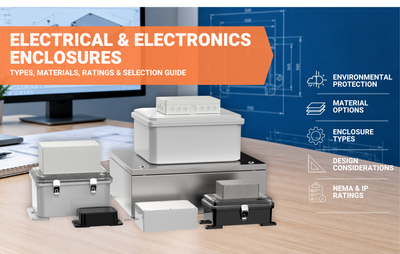
Whether you're developing a new electronic device, protecting industrial controls, or selecting a weatherproof housing for outdoor equipment, the right enclosure is an essential part of a reliable design.
Electrical and electronics enclosures come in a wide variety of materials, sizes, and configurations. Understanding their differences can help engineers, product designers, and purchasing teams select a solution that meets both technical requirements and production needs.
This guide covers common enclosure types, material comparisons, environmental protection ratings, enclosure design considerations, and available customization options.
An electrical or electronics enclosure is a protective housing used to contain electrical wiring, electronic components, circuit boards, controls, sensors or related equipment.
Enclosures help protect sensitive components from environmental hazards such as dust, moisture, and physical impact. Depending on their design, they can also help limit accidental contact with electrical components, support secure equipment mounting, and provide controlled access for installation or maintenance.
Although the terms electrical enclosure and electronics enclosure are often used interchangeably, their applications can differ.
The appropriate enclosure depends on what it needs to protect, where it will be installed, and which safety or environmental requirements apply.
Electrical and electronics enclosures can be categorized by material, design feature, protection provided and intended application.
Plastic enclosures are commonly used for housing electronic components because they are lightweight, easy to modify with CNC machining, versatile, and available in a wide range of sizes and configurations.
Common plastic materials include polycarbonate and ABS. Many designs incorporate built-in PCB mounting bosses, removable covers, various external mounting options, flanges, other features that simplify equipment installation.
Plastic electronics enclosures are commonly used for:
Nonmetallic construction can also be beneficial for devices using internal wireless antennas due to the absence of radio-frequency sheilding commonly associated with metal enclosures. When EMI could affect performance, the complete device assembly should be evaluated.
Explore Polycase Plastic Enclosures
Metal enclosures are commonly selected for applications requiring premium durability, EMI/RF shielding or specific thermal characteristics.
Common materials include aluminum, carbon steel, and stainless steel.
Depending on the material and construction, metal enclosures can offer benefits such as corrosion resistance, heat dissipation, and electromagnetic interference shielding.
Metal electrical enclosures are frequently used for industrial controls, instrumentation, electrical equipment, and medical devices.
Explore Polycase Metal Enclosures
However, not all weatherproof enclosures provide the same level of protection.
An enclosure designed to withstand rain or splashing water may not be suitable for pressure washing or submersion. The required protection level should be established before selecting a product.
NEMA and IP ratings provide standardized ways to evaluate environmental protection.
Explore Polycase IP-Rated Enclosures
Electrical junction boxes house and protect electrical connections, wiring splices, and related components.
They are available in plastic and metal construction, with designs intended for indoor or outdoor installations.
When selecting a junction box, important considerations include environmental exposure, enclosure dimensions, cable entry locations, accessibility, and applicable electrical code requirements.
Not every general-purpose electronics enclosure is suitable for use as a code-compliant electrical junction box. The specific product's listing, intended use, and installation requirements must be verified.
Industrial electrical cabinets generally provide larger internal spaces for electrical control systems, distribution equipment, automation components, and other complex assemblies.
They may include mounting panels, DIN rails, hinged covers, locks, and cable-management features.
Cabinets are often constructed from steel or stainless steel, although material selection varies by application.
For smaller control systems, instrumentation, and electronic assemblies, a compact wall-mounted electrical enclosure may provide a more space-efficient alternative to a full-sized cabinet.
| MATERIAL | KEY ADVANTAGES | COMMON CONSIDERATIONS | TYPICAL APPLICATIONS |
| Polycarbonate | Impact resistance, lightweight construction, outdoor rated protection, easy to modify with CNC machining | UV stability, chemical compatibility and protection level depend on grade and design | Telecommunication devices, remote monitoring, SCADA, outdoor electronic applications |
| ABS Plastic | Cost-effective, lightweight, large variety of styles to choose from | May require alternative PCB mounting options due to mounting boss locations or availability | PCB housings, potting boxes, desktop electronics, handheld devices, indoor electronic applications |
| Aluminum | Lightweight metal, thermal conductivity, inherent level of EMI shielding | Conductivity, grounding, corrosion and wireless performance require evaluation | Instrumentation, industrial electronics |
| Carbon Steel | Strong, durable, modern powder-coat finish | May require protective coatings to resist corrosion | Electrical controls, industrial equipment |
| Stainless Steel | Strong corrosion resistance, durable construction | Higher cost and weight than many alternatives | Healthcare equipment, marine environments |
Polycarbonate is a popular choice for electrical and electronics enclosures requiring impact resistance and dependable performance.
Many polycarbonate enclosure designs are well suited to industrial, commercial, and outdoor applications.
Depending on the specific model, features may include UV-stabilized material, environmental sealing, transparent covers, mounting flanges, and NEMA or IP ratings.
Polycarbonate is especially useful when a nonmetallic enclosure must withstand demanding conditions without the weight of a metal housing.
Browse Polycarbonate Enclosures
Acrylonitrile butadiene styrene (ABS) is a versatile thermoplastic frequently used for indoor electronic equipment.
ABS offers a practical combination of durability, affordability, and manufacturing flexibility.
It is commonly used for desktop electronics, handheld devices, circuit board housings, and general-purpose electronic boxes.
Aluminum provides a lightweight metal enclosure option with good thermal conductivity and natural corrosion resistance in many environments.
Its electrical conductivity can support electromagnetic shielding when the enclosure, seams, openings, and grounding are appropriately designed.
However, metal construction can interfere with wireless signals from internal antennas. Designers should consider antenna placement and radio-frequency requirements when selecting aluminum.
Carbon steel is commonly selected for applications requiring an exceptionally tough material and economical metal construction.
Protective coatings can improve corrosion resistance, but their suitability depends on environmental exposure and coating integrity.
Stainless steel provides enhanced corrosion resistance and is frequently used in demanding industrial environments.
Both materials are available in enclosure designs intended for electrical controls, instrumentation, and equipment protection.
Environmental protection ratings help engineers identify enclosures suitable for specific operating conditions.
Two widely used systems are NEMA enclosure types and IP ratings.
Although both address environmental protection, they are not interchangeable.
NEMA enclosure types are defined by the National Electrical Manufacturers Association and describe protection characteristics for electrical equipment enclosures.
Depending on the type, requirements address conditions such as water exposure, dust, corrosion, and other environmental hazards.
Common NEMA enclosure types include:
| NEMA TYPE | GENERAL PROTECTION |
| NEMA 1 | Indoor use; basic protection against contact and limited falling dirt |
| NEMA 3R | Indoor or outdoor use; protection against rain, sleet, and external ice formation |
| NEMA 4 | Indoor or outdoor use; protection against windblown dust, rain, splashing water, and hose-directed water |
| NEMA 4X | NEMA 4 protection with additional corrosion resistance |
| NEMA 6 | Indoor or outdoor use; protection including temporary submersion under specified conditions |
| NEMA 6P | Indoor or outdoor use; protection including prolonged submersion under specified conditions |
| NEMA 12 | Indoor use; protection against circulating dust, falling dirt, and dripping noncorrosive liquids |
The required rating should reflect the actual installation environment rather than simply selecting the highest available number.
For example, an outdoor enclosure exposed to rain may have different requirements than equipment exposed to frequent washdowns or temporary flooding.
Ingress Protection (IP) ratings are defined by IEC 60529.
An IP rating typically contains two digits:
Common ratings include:
| IP RATING | PROTECTION |
| IP54 | Dust-protected and resistant to splashing water |
| IP65 | Dust-tight and protected against water jets |
| IP66 | Dust-tight and protected against powerful water jets |
| IP67 | Dust-tight and protected against temporary immersion under specified test conditions |
| IP68 | Dust-tight and protected against continuous immersion under manufacturer-specified conditions |
An IP68 enclosure is not automatically appropriate for every underwater application. The permitted immersion depth and duration must be verified.
No. NEMA 4X and IP66 address some similar environmental hazards, but the ratings are not identical.
NEMA 4X includes corrosion-resistance requirements that IP66 does not evaluate.
NEMA and IP classifications should not be treated as direct substitutes without checking the relevant standards and product documentation.
Important: A product described as IP-equivalent is not necessarily independently certified to that IP rating. Always verify whether the manufacturer identifies a formal rating or an equivalent protection level.
Explore Polycase IP-Rated Enclosures
Selecting an enclosure begins with understanding the equipment and its operating environment.
The following considerations can help narrow the available options.
Start by identifying where the enclosure will be installed.
Will the equipment operate indoors, outdoors, or in an industrial environment with frequent exposure to dust, water, chemicals, or temperature fluctuations?
For outdoor installations, consider direct sunlight, precipitation, temperature changes, and potential condensation.
The operating environment influences material selection, gasket requirements, environmental ratings, and mounting configuration.
Choose a material that supports the application's mechanical, electrical, and environmental requirements.
For example, a UV-stabilized polycarbonate enclosure may be appropriate for an outdoor monitoring device, while an ABS housing may be sufficient for indoor desktop electronics.
Applications requiring metal construction, thermal conductivity, or electromagnetic shielding may benefit from aluminum or steel.
Material properties should be evaluated alongside the design and specifications of the finished enclosure.
An enclosure must provide enough internal space for all components, wiring, connectors, and required clearances.
When determining dimensions, consider:
External enclosure dimensions do not always represent usable internal space.
Always review internal drawings and three-dimensional models before finalizing a design
Determine whether the application requires protection against dust, splashing water, hose-directed water, temporary immersion, or prolonged submersion.
Select an enclosure with documented protection characteristics appropriate for those conditions.
Remember that drilling holes, adding cable entries, or modifying an enclosure will affect its environmental sealing.
The finished assembly, including connectors, glands, vents, and other penetrations, must be evaluated against the required protection level. Accessories like connectors, glands and vents must meet or exceed the required NEMA or IP rating in order to maintain adequate protection.
Enclosures are available with different mounting configurations, including external flanges, mounting feet, mounting accessories (such as pole mounting kits) and numerous internal mounting options.
The mounting arrangement should accommodate the equipment weight, accessibility, and environmental exposure.
For internal components, PCB mounting bosses, panels, and DIN rails can simplify installation and assembly.
Many electronic devices require cables, antennas, connectors, switches, or other components to pass through the enclosure walls.
These features should be planned during enclosure selection rather than added as an afterthought.
Consider the required cutout dimensions, connector clearances, cable gland specifications, and sealing methods.
Electrical and electronic components generate heat during operation.
A sealed enclosure can limit airflow, making thermal management an important part of the design process.
Potential solutions include selecting an appropriately sized enclosure, using suitable thermal-management components, or incorporating vents where environmental requirements permit.
The correct approach depends on internal heat generation, ambient temperature, enclosure material, and the allowable operating temperature of the equipment.
For products moving into commercial production, enclosure availability and customization capabilities can be as important as the initial design.
Evaluate whether a standard enclosure can accommodate the product with secondary modifications such as CNC machining.
This approach may reduce tooling requirements and simplify procurement compared to developing a fully custom molded enclosure.
One important decision in enclosure design is whether to use an existing enclosure or develop a completely custom molded housing.
Standard enclosures are existing product designs available in established sizes and configurations.
They can provide advantages such as:
For many applications, an off-the-shelf enclosure provides the required functionality without the expense or complexity of custom tooling.
Shop off-the-shelf enclosures with Polycase
Customized enclosures begin with an existing housing that is modified to meet project-specific requirements.
Common modifications include:
CNC Machining: Precision cutouts, specialized hole types (threaded, counterbore, etc.), recesses, and other modifications for connectors, switches, displays, or cable entries.
Digital Printing: Logos, component identifiers, infographics, instructions, and graphics printed directly onto the enclosure surface.
Laser Marking: Durable functional markings commonly used for dials and identifiers on compatible enclosure materials.
Accessories: Compatible mounting panels, DIN rails, cable-management, venting solutions components, and other hardware.
This approach can combine the benefits of a standard enclosure with the flexibility required for a finished electronic product.
Explore customization services with Polycase.
Fully custom enclosure manufacturing involves developing a new enclosure design, which may require new tooling, molds, fabrication processes, and engineering validation.
This approach may be appropriate when no standard enclosure can satisfy the product's requirements.
However, it can also involve higher development costs, longer timelines, and additional design responsibilities.
Polycase specializes in standard enclosure products and secondary customization services rather than custom injection mold development.
Enclosure selection affects more than the appearance of the finished product.
Several common oversights can create problems during installation, testing, or production.
An enclosure may appear large enough but lack sufficient internal clearance for connectors, mounting hardware, components or wiring.
Review detailed drawings and account for internal features like screw towers, mounting bosses and draft before selecting a model.
Plastic construction alone does not establish an environmental protection rating.
A weather-resistant enclosure generally requires an appropriate design, sealing system, and documented performance characteristics.
A properly rated enclosure can lose its intended environmental protection if cable penetrations are not adequately sealed.
Plan connector and cable gland placement early, and verify the protection level of the completed assembly.
Components housed inside a sealed enclosure can experience elevated operating temperatures.
Evaluate internal heat generation and the enclosure's operating environment before finalizing the design, venting solutions may be required to prevent overheating and condensation.
Metal enclosures may interfere with wireless signals from internal antennas.
For wireless devices, consider antenna placement and material selection as part of the overall design
Connector placement, machining access, graphics, and mounting requirements can affect the suitability of an enclosure.
Planning these details early can reduce design revisions and simplify production.
Choosing an enclosure manufacturer involves more than comparing prices.
A dependable supplier should offer products and services that support both the technical requirements of the application and the purchasing needs of the organization
Look for a range of enclosure sizes, materials, design features (like hinged covers), mounting options styles, and protection ratings.
A broad selection makes it easier to identify an existing product that meets your requirements
Detailed specifications, dimensional drawings, and 3D models help engineers evaluate component fit and installation requirements.
Documentation is especially important when selecting enclosures for equipment that must meet specific environmental or safety standards.
Manufacturers should clearly identify applicable environmental ratings and product certifications.
Review documentation for the specific model rather than assuming all products within a material category or product family have identical ratings.
Access to machining, printing, and compatible accessories can simplify procurement and reduce the need to coordinate with multiple suppliers.
Reliable availability is particularly important for manufacturers ordering enclosures for ongoing production.
Evaluate standard inventory, customization lead times, and the supplier's ability to support repeat orders.
Manufacturing location may influence procurement preferences, supply-chain planning, and applicable sourcing requirements.
When domestic manufacturing is important, verify the country of origin of the specific enclosure model.
Polycase manufactures many of its plastic enclosures in Avon, Ohio, USA, giving customers access to American-made enclosure options backed by domestic manufacturing operations.
For in-stock, non-customized products, orders placed Monday-Friday before 3:00 p.m. Eastern Time ship the same business day, helping OEMs quickly source enclosures for prototyping, testing, and production needs.
Polycase offers a broad selection of standard electrical and electronics enclosures for industrial, commercial, and outdoor applications.
Our product lineup includes polycarbonate, ABS, aluminum, carbon steel, and stainless steel enclosure options in a variety of sizes and configurations.
Many Polycase plastic enclosures are manufactured in Avon, Ohio, and our catalog includes products with a range of NEMA and IP protection ratings.
To help customers move from design to production, Polycase also offers in-house CNC machining, digital printing, laser marking, and compatible enclosure accessories.
Whether you're developing a prototype, selecting a housing for industrial equipment, or sourcing enclosures for an ongoing production order, Polycase provides tools to help you compare options and find an appropriate solution.
Explore Your Options:
An electronics enclosure is a protective housing designed to contain circuit boards, sensors, wiring, and other electronic components. Enclosures help protect equipment from environmental exposure, physical damage, and accidental contact. They are available in plastic and metal materials with different sizes, mounting options, and environmental protection ratings.
Electrical enclosures commonly house power switches, controls, and other electrical components. Electronic enclosures typically contain printed circuit boards (PCBs), sensors, and other electronic components. The terms often overlap, and the appropriate enclosure depends on the equipment, installation environment, and applicable requirements.
Click here for more information on electrical enclosure standards.
The best material depends on the application. Polycarbonate is often suitable for rugged and outdoor electronics, while ABS is commonly used for indoor electronic housings. Aluminum offers thermal conductivity and potential EMI shielding, while steel and stainless steel provide durable metal construction.
Visit our Enclosure Material Selection Guide for more help.
Some plastic electrical enclosures are designed and rated for water protection, but not all plastic enclosures are waterproof. Check the specific product's NEMA or IP rating and sealing requirements to determine whether it is suitable for rain, water jets, or submersion.
NEMA enclosure types and IP ratings both describe environmental protection, but they evaluate different characteristics. IP ratings focus on protection against access, solid-object ingress, and water ingress. NEMA types may include additional requirements such as corrosion resistance. The two systems should not be treated as directly interchangeable.
Yes. Many standard electronic enclosures can be customized with CNC-machined cutouts, UV-printed graphics, laser marking, and compatible accessories. Customizing an existing enclosure can provide project-specific modifications without requiring development of a completely new mold.
Start with the dimensions of the internal components, then account for mounting hardware, wiring, connector clearances, heat management, and future servicing. Review the enclosure's internal dimensions and technical drawings before making a final selection.
Yes, provided the specific enclosure is designed for the intended outdoor conditions. Consider environmental ratings, UV exposure, temperature, corrosion resistance, mounting, and sealing. Outdoor suitability should be confirmed using the product's specifications rather than material alone.
Electrical and electronics enclosures are available from specialized enclosure manufacturers and industrial suppliers. Polycase offers standard plastic and metal enclosures, technical documentation, and in-house customization services to help customers select and configure housings for their applications.
The right electrical or electronics enclosure helps protect equipment, simplify installation, and support long-term product reliability.
By evaluating enclosure materials, environmental ratings, dimensions, mounting requirements, and customization options, you can narrow the available choices and identify a housing suited to your project.
Polycase offers a wide selection of standard enclosures, along with customization capabilities to help meet specific design and production requirements.
Explore Electrical Enclosures or View Customization Options to get started.