

November 17, 2026
- URL
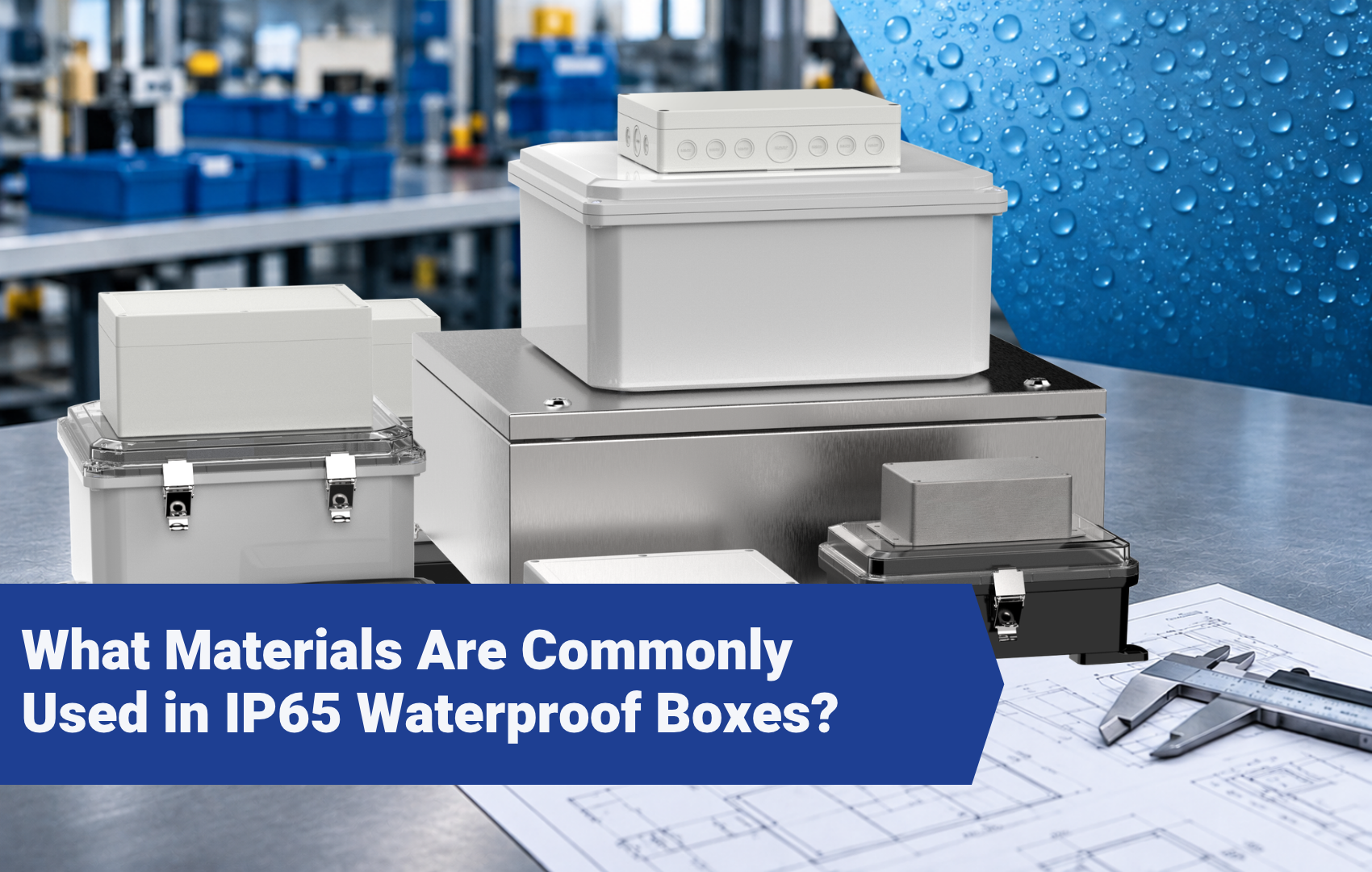
When selecting an enclosure for electronic equipment, material choice plays an important role in durability, environmental protection, and long-term performance. For applications exposed to dust, rain, water spray, or industrial conditions, IP65-rated enclosures are a common solution.
IP65 waterproof boxes are commonly manufactured from polycarbonate, ABS plastic, aluminum, and stainless steel. Each material offers different advantages depending on the application, operating environment, temperature requirements, and mechanical demands.
However, the enclosure's material alone does not determine its IP rating. An IP65 rating applies to the enclosure's tested construction, including its lid, seals, fasteners, and openings.
Understanding these differences helps engineers, OEM manufacturers, and equipment designers select an appropriate enclosure for their applications.
IP65 is an Ingress Protection rating defined by IEC 60529. The rating describes how effectively an enclosure protects its contents against solid objects and water.
The two digits represent different levels of protection:
An IP65-rated enclosure is suitable for many environments where electronic components require protection from dust, rain, and water spray.
However, IP65 does not mean an enclosure can be submerged in water. Applications involving temporary or continuous immersion require evaluation against appropriate immersion ratings, such as IP67 or IP68.
It's also important to distinguish between water-resistant and waterproof. Although IP65 enclosures are often marketed as waterproof boxes, their certified protection is limited to the conditions covered by the IP65 test.
The most common materials used for IP65-rated electronics enclosures include polycarbonate, ABS plastic, aluminum, and stainless steel.
Each material offers distinct performance characteristics.
| MATERIAL | PRIMARY ADVANTAGES | COMMON APPLICATIONS |
| Polycarbonate | High impact resistance, availability of UV-stabilized grades, lightweight construction | Outdoor electronics, industrial monitoring, telecommunications |
| ABS plastic | Cost-effective, lightweight, easy to machine | Indoor controls, commercial electronics, protected equipment installations |
| Aluminum | Good mechanical strength, thermal conductivity, electromagnetic shielding potential | Industrial electronics, instrumentation, control equipment |
| Stainless steel | Corrosion resistance, strength, durability in demanding environments | Food processing, washdown environments, industrial facilities |
Polycarbonate is a popular material for protective electronic enclosures, particularly in applications requiring impact resistance and environmental durability.
Its combination of strength, relatively low weight, and design flexibility makes it suitable for a wide range of industrial and commercial applications.
Advantages of polycarbonate enclosures include:
Polycarbonate is frequently selected for outdoor electronic equipment, industrial sensors, communication systems, and monitoring devices.
For outdoor installations, engineers should verify that the specific enclosure uses a material formulation suitable for prolonged UV exposure. Not all polycarbonate grades provide identical weathering performance.
Polycarbonate enclosures are available in multiple configurations, including wall-mount, surface-mount, and general-purpose designs.
Best suited for: Outdoor electronic equipment, industrial controls, monitoring devices, and applications requiring increased impact resistance.
Acrylonitrile butadiene styrene (ABS) is another widely used enclosure material.
ABS offers a practical balance of cost, durability, and manufacturability, making it popular for commercial electronics and general-purpose equipment.
Advantages of ABS enclosures include:
ABS is commonly used for indoor electronic controls, circuit board housings, communication devices, and commercial equipment.
Although ABS enclosures can be designed and tested to meet IP65 requirements, standard ABS formulations are generally not suitable for prolonged outdoor UV exposure.
Environmental exposure, temperature, and chemical compatibility should be evaluated before selecting ABS for demanding installations.
Best suited for: Indoor electronics, commercial equipment, control modules, and cost-sensitive OEM applications.
Aluminum provides a combination of mechanical strength, relatively low weight, and thermal conductivity.
For electronic equipment that generates heat or requires a metal housing, aluminum can offer advantages over plastic alternatives.
Advantages of aluminum enclosures include:
Aluminum is often used for instrumentation, industrial electronics, communication equipment, and electronic control systems.
An aluminum enclosure does not automatically provide adequate thermal management or EMI shielding. Actual performance depends on the enclosure's design, wall thickness, surface treatments, electrical continuity, and installation.
To achieve IP65 protection, the enclosure must also incorporate suitable sealing and fastening components.
Best suited for: Industrial instrumentation, electronic controls, and equipment with specific mechanical, thermal, or shielding requirements.
Stainless steel is commonly selected for demanding industrial environments where strength, cleanability, or corrosion resistance is a priority.
It is particularly useful in applications involving frequent cleaning, moisture, and exposure to certain chemicals.
Advantages of stainless steel enclosures include:
Stainless steel enclosures are commonly used in food processing facilities, industrial automation, manufacturing environments, and chemical processing operations.
Different stainless steel grades provide different levels of corrosion resistance. For example, 316 stainless steel may be preferred over 304 stainless steel in certain chloride-rich environments.
IP65 protection should not be confused with chemical resistance or washdown suitability. Cleaning methods, chemicals, and environmental conditions must be evaluated separately.
Best suited for: Industrial environments requiring robust metal construction and corrosion resistance.
The best enclosure material depends on the intended application rather than the IP rating alone.
For many outdoor electronics applications, UV-stabilized polycarbonate is a strong starting point because it combines impact resistance with relatively lightweight construction.
For indoor commercial electronics, ABS may provide a more economical solution.
Aluminum may be preferable when thermal conductivity, structural characteristics, or shielding requirements are important.
Stainless steel is often selected for demanding industrial environments where corrosion resistance and durability are primary considerations.
When comparing enclosure materials, engineers should evaluate:
Evaluating these factors early can help reduce design changes and sourcing complications later in the product development process.
Yes. Plastic enclosures can provide reliable protection for outdoor electronic equipment when they are manufactured from appropriate materials and designed for the expected environmental conditions.
Polycarbonate is frequently used for outdoor applications because UV-stabilized grades offer good weathering characteristics and impact resistance.
However, an IP65 rating alone does not guarantee long-term outdoor durability.
Engineers should also consider:
For applications involving prolonged water exposure or possible submersion, a higher ingress protection rating may be necessary.
Many standard electronics enclosures can be customized to accommodate specific components, connectors, and installation requirements.
Common customization options include:
For OEM manufacturers, customizing an existing enclosure can reduce the need for new tooling while supporting product-specific design requirements.
Polycase offers in-house enclosure customization services, including CNC machining and digital printing, for compatible standard enclosure models.
Important: Machining holes or adding components can affect an enclosure's environmental protection. Engineers must evaluate whether the completed assembly maintains the required IP rating, including the sealing of connectors, cable glands, and other openings.
For OEM manufacturers, enclosure selection involves more than choosing the right material or environmental rating.
The enclosure must also support efficient product assembly, reliable sourcing, and consistent production.
Important sourcing considerations include:
Using an existing enclosure design can reduce development time compared with creating a fully custom molded housing.
Standard enclosures are available in established dimensions and configurations, allowing engineers to select a suitable housing during early product development.
Access to dimensional drawings and CAD models helps engineers evaluate internal clearances, PCB mounting locations, and connector placement before purchasing.
Polycase provides downloadable technical documentation for many of its enclosure models.
In-house CNC machining and graphics services can simplify procurement by allowing customers to purchase modified enclosures directly from the manufacturer.
Many Polycase plastic enclosures are manufactured in Avon, Ohio, USA.
For qualifying in-stock, non-customized products, orders placed before 3:00 p.m. Eastern Time ship the same business day.
Domestic manufacturing and established stock programs can be valuable considerations for OEMs managing production schedules and repeat purchasing requirements.
Polycarbonate and ABS are two common plastics used in IP65-rated electronic enclosures. Polycarbonate is often selected for impact resistance and outdoor applications, while ABS is commonly used for indoor electronics and cost-sensitive equipment.
Polycarbonate may be preferable for demanding environments requiring higher impact resistance or outdoor weatherability. However, both polycarbonate and ABS enclosures can achieve IP65 ratings when their complete designs meet the applicable test requirements.
An appropriately designed IP65 enclosure can protect against rain and water jets under its rated conditions. Actual suitability depends on installation, sealing, environmental exposure, and whether the completed assembly maintains the specified protection.
IP65 provides dust-tight protection and resistance to water jets, but it does not establish protection against immersion. Applications involving submersion require a suitable immersion rating and an enclosure designed for those conditions.
Not necessarily. Metal enclosures may offer advantages in mechanical strength, heat transfer, or EMI shielding, while plastic enclosures can provide lightweight construction, electrical insulation, and corrosion resistance. The best choice depends on the application.
Yes. Polycase offers a range of rated electronic enclosures for individual purchases and larger production quantities. Available quantity pricing and product specifications can be reviewed through the Polycase website.
Selecting the right IP65 waterproof electronics enclosure starts with understanding the operating environment, required protection level, and material characteristics.
Polycarbonate, ABS, aluminum, and stainless steel can all be used in IP65-rated enclosure designs, but each offers different advantages for industrial and commercial applications.
Polycase offers a broad selection of plastic and metal electronics enclosures, along with customization services to support engineering and OEM production requirements.
Explore Polycase's electronic enclosure options to compare available materials, dimensions, environmental ratings, and customization capabilities for your next project.