

May 12, 2021
- Url
 Common household and workplace devices are among the most common sources of EMI. Some devices, such as TV remote controls, create relatively small and weak fields. Others, like microwave ovens and smartphones, create more powerful ones. When these fields come into contact with other devices, they can create detrimental interference. Furthermore, EMI doesn’t even have to originate from an outside source. Internal EMI, in which one of a device’s components generates interference in another component, is another common source of problems. Upstream problems with the quality and conditioning of power sources are also frequent culprits, and these two types of internal EMI working together can create real headaches for device designers and builders. As if those sources didn’t cause enough problems, nature itself can create EMI. Atmospheric phenomena like thunderstorms and solar storms are natural emitters of electromagnetic radiation, and they can have similar detrimental effects on electrical devices. You might also hear about radio frequency interference (RFI) in the context of discussions about EMI, as the two terms are often used together or even interchangeably. RFI is a subset of EMI that occupies the band of the electromagnetic spectrum known as the radio frequency (RF) band. It’s an especially common type of interference because so many devices, including many common types of power switching equipment and electric motors, can emit on frequencies in this spectrum.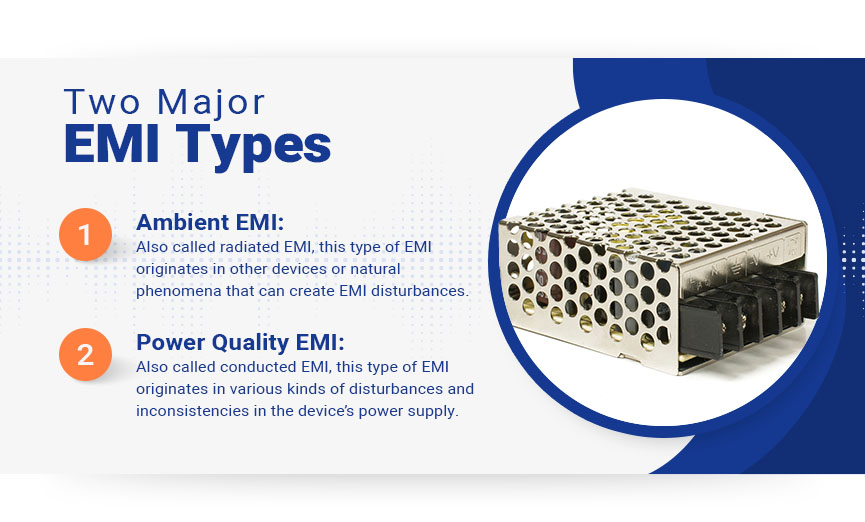
 These are some types of devices especially vulnerable to EMI:

